

Daido Steel Group's Policy on Human Rights
1. Basis for Respecting Human Rights and Priority Issues
The Daido Steel Group will promote initiatives to respect human rights in line with the United Nations Guiding Principles on Business and Human Rights. In addition, based on the understanding that the human rights described in the International Bill of Human Rights and the Core Labor Standards established by the International Labor Organization (ILO) are the minimum human rights, the Daido Steel Group will support and comply with international norms on human rights and the laws and regulations of all countries, and will respect fundamental human rights in all aspects of our business activities. However, if the laws and regulations of each country are inadequate compared to international norms or conflict with them, we will strive to respect the international principles of human rights.
In promoting initiatives to respect human rights based on this policy, the Daido Steel Group has established priority issues related to human rights as described in the appendix "Priority issues of the Daido Steel Group's Policy on Human Rights.” These priority issues shall be reviewed as appropriate in light of changes in social and business trends.
2. Scope
This policy applies to all officers and employees (including part-time employees, part-timers, and temporary employees) of the Daido Steel Group. In addition, if adverse human right impacts by business partners (such as suppliers, partner companies, and other related parties and/or individuals) of the Daido Steel Group are directly linked to the Daido Steel Group’s business, products, and services, we will encourage them to understand and comply with this policy.
3. Education
In order to ensure a correct understanding of human rights and a full awareness of this policy throughout our business activities, we will provide systematic and continuous education to Daido Steel Group officers and employees.
4. Implementation of Human Rights Due Diligence
We have established a human rights due diligence system and continuously implement the following steps:
(1) Identification and evaluation of actual or potential negative impacts on human rights
(2) Prevention and mitigation of identified negative impacts on human rights
(3) Monitoring for verification of effectiveness
(4) Public disclosure of information to fulfill accountability
5. Correction and Remedy
We have established a remediation mechanism, and will implement effective correction and remedy in the event that the Daido Steel Group's business activities have a direct or indirect negative impact on human rights.
6. Consultation and Dialogue with Stakeholders
We value consultation and dialogue with stakeholders inside and outside our company, and will work to identify, rectify, and resolve human rights issues.
Appendix: Priority issues of the Daido Steel Group's Policy on Human Rights
(1) Elimination of Discrimination
The Daido Steel Group (the “Group”) respects diversity and does not discriminate on any basis of race, ethnicity, place of birth, color, religion, gender, age, creed, social status, illness, disability, sexual orientation, gender identity, marital status, or the presence or absence of children.
(2) Prohibition of Harassment
The Group does not condone sexual harassment, power harassment, or any other harassment that infringes on human rights on the basis of gender or position. In the event that harassment occurs, the Group will take prompt and appropriate action.
(3) Respect for the Right to Work
The Group respects the freedom of association and the right to collective bargaining in all countries and regions where it conducts business and builds sound labor-management relations through honest dialogue with employees or their representatives.
In addition, the Group complies with labor and safety laws and regulations of all countries and regions where it operates, reduces working hours as necessary, and prevents excessive work.
Moreover, the Group complies with the principle of equal pay for equal work and the laws and regulations for minimum wages set by all countries, regions, and industries where it conducts business activities and ensures that every employee is paid at or above a living wage.
(4) Prohibition of Forced Labor and Child Labor
The Group prohibits and does not use forced or involuntary labor in all countries and regions where it operates.
In addition, the Group respects children’s rights in accordance with the UNICEF Children’s Rights and Business Principles and the UN Convention on the Rights of the Child and prohibits the labor and employment of persons under the legal minimum working age in each country or region and does not use them.
(5) Creation of motivating work environment
The Group will respect the individuality and diversity of all people and promote the creation of a workplace that motivates employees. In addition, as part of its efforts to create a positive work environment, the Group will strive to employ local people and support the resolution of labor issues in local communities, including employing socially vulnerable people.
Promotion organization for respect for human rights
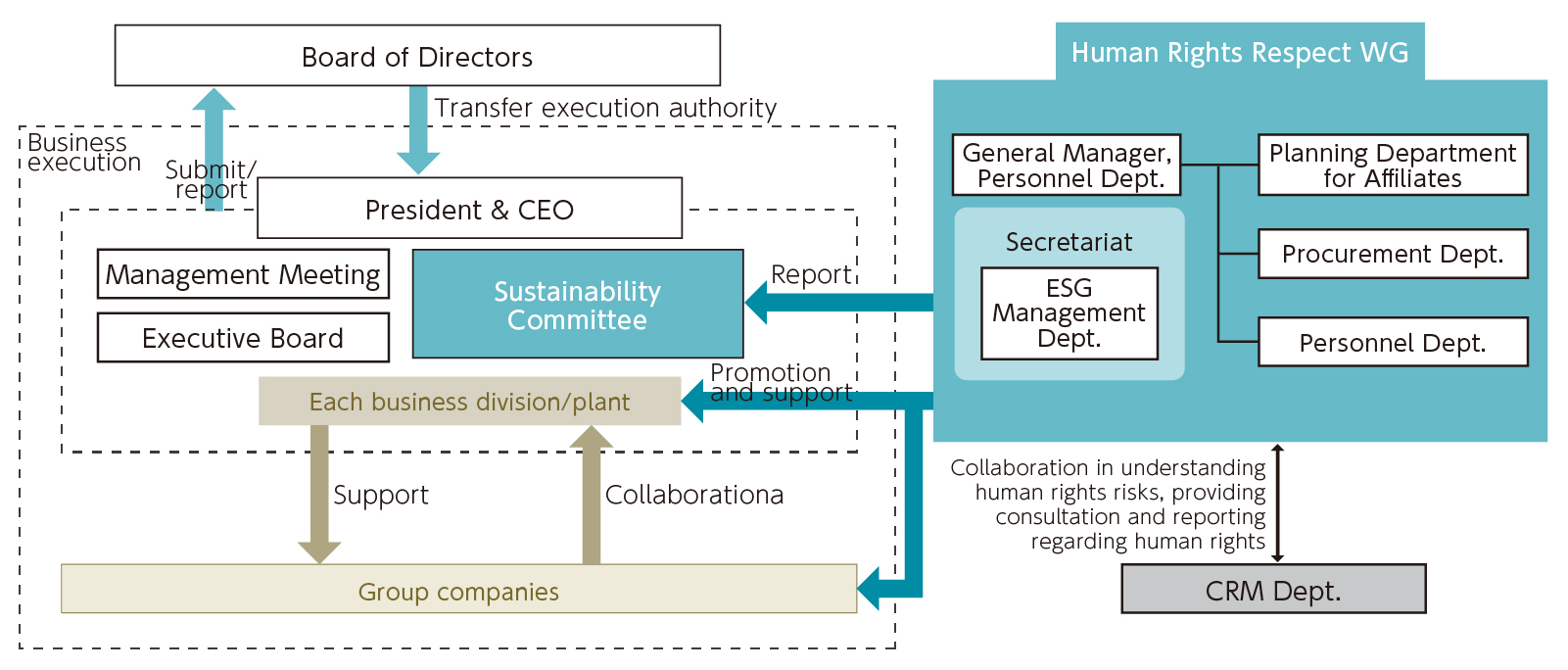
Under the supervision of the Board of Directors, we have established a Human Rights Respect Working Group (WG) under the Sustainability Committee, chaired by the President and CEO. The WG regularly reports on the status of human rights initiatives to this Committee. The Human Rights Respect WG plans and implements human rights due diligence not only within the company but also across group companies, identifies adverse impacts, and undertakes efforts to avoid, prevent, and mitigate such impacts. It also conducts awareness-raising activities for group companies and the supply chain.
Human Rights Due Diligence
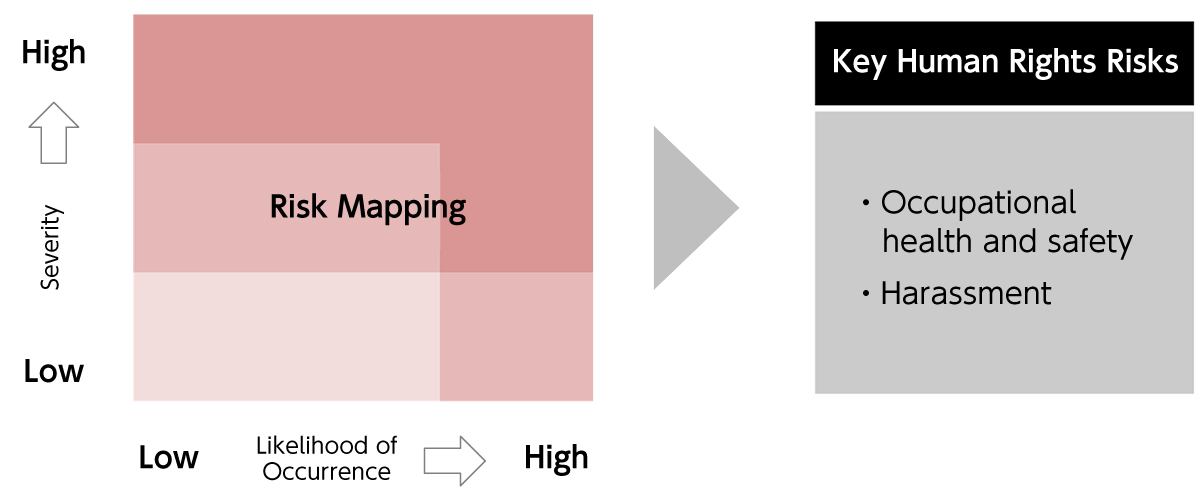
Through employee surveys conducted within the Company and its group companies, we identified potential adverse impacts on human rights (human rights risks) that require attention in the course of our business activities. Using domestic and international guidelines, as well as advice from an external consulting firm, we assessed the significance of these risks based on two factors: severity and likelihood of occurrence. As a result, we identified "occupational health and safety" and "harassment" as key human rights risks. We will continue to review these risks through our due diligence efforts and engagement with stakeholders. Additionally, if it becomes evident that our business activities are causing or contributing to adverse human rights impacts in other areas, we will fulfill our responsibility to respect human rights by taking appropriate corrective actions.
Engagement with the Supply Chain
The Daido Steel Group requests that all of its suppliers likewise fulfill their responsibility to respect human rights, and the Group will continue to address these matters appropriately.
Stakeholder Access Point (JaCER)
To further strengthen our commitment to respecting human rights, we joined the Japan Center for Engagement and Remedy on Business and Human Rights (JaCER) in 2024.
JaCER provides a non-judicial grievance mechanism—the “Engagement and Remedy Platform”—which is aligned with the UN Guiding Principles on Business and Human Rights. Through this platform, JaCER receives complaints and reports concerning actual or suspected violations of international codes of conduct or national regulations, and supports member companies in addressing such grievances from a professional standpoint.
Through the “Engagement and Remedy Platform,” the Daido Steel Group also accepts human rights–related complaints from all stakeholders involved in the Group’s business activities, including employees, customers, business partners, local communities, and others.
The platform is available in Japanese, English, and Simplified Chinese, and also offers multilingual reporting forms using automated translation. Anonymous reporting is possible to ensure that users can submit concerns safely. The privacy of reporters is protected, and all information related to reports is kept strictly confidential.
Note: Employees of the Daido Steel Group companies are encouraged to use the “Daido Steel Group Hotline,” which is communicated internally, for faster response.