

Specialty Steel Research
To enhance the competitiveness of our steel products business division and create next-generation products, we are leveraging our unparalleled alloy design technology to conduct technological development of a range of materials, including structural steel, corrosion and heat-resistant materials, and mold materials.
Structural Steel
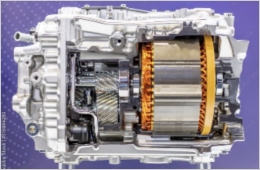
High-strength gear steel for e-Axle (Carburized Steel)
We are developing steel materials and production methods to contribute to the manufacturing of e-Axle reduction gears, which require greater fatigue strength than conventional reduction gears.
Our DEG series of vacuum-carburized steels, developed through the integration of our “ModulTherm” vacuum carburizing furnace and shot peening (SP) technology, achieves approximately twice the fatigue strength of conventional steels of the same type. In addition, we offer a diverse lineup of gear steels tailored to meet a wide range of gear performance requirements.
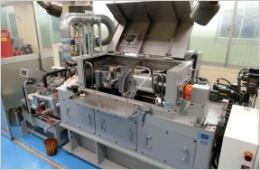
Simulation-based Evaluation Method for e-Axle Reduction Gears
Gears used in e-Axle speed reducers are subjected to more severe sliding conditions compared to conventional applications.
Our latest roller pitching test machine enables us to evaluate gear operation under all sliding conditions, contributing to the realization of high-performance gears.
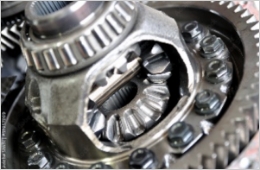
High-Toughness Gear Steel
High-toughness gear steel (DSGB steel) has excellent cold forging properties and high impact strength properties that contribute to the production of smaller, lighter gears and the achievement of carbon neutrality.
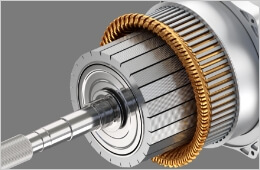
Steel capable of eliminating softening annealing treatment before cold forging
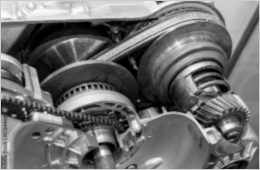
Gear steels (ALFA steel/S-ALFA steel) and induction-hardened steel (HAC steel), which feature outstanding cold-forging properties and enable the omission of softening annealing before cold forging, contribute to the realization of carbon neutrality.
Steel for High-Temperature Carburizing
The process of carburizing steel at high temperatures reduces the time required for the completion of the carburizing process. We offer a variety of steel for high-temperature carburizing, a process that contributes to energy savings and the achievement of carbon neutrality. These include ATOM steel, an ultra-fine grain steel for carburizing that is capable of suppressing grain coarsening during the high-temperature carburizing process, and other gear steels with excellent manufacturability and resistance to abnormal grain growth under high-temperature conditions.
Tool Steel
Hot Stamping Die Steel
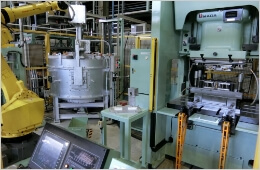
We use hot stamping equipment, comprising servo presses, heating furnaces, and robots, to evaluate and study the effects of material properties and die temperatures on die damage during hat-shaped-bending processes.
We have developed DHA-HS1, a die steel suitable for hot stamping, featuring high hardness and high thermal conductivity. We are also striving to find solutions for in-die trimming.
Hot Work Tool Steel (Die-Casting)
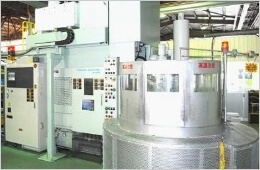
We use a small die casting machine, heat checking testers, and an erosion loss tester to evaluate and study how material properties affect damages of a die.
We have developed high-hardenability steels (DHA-WORLD, DH31-EX) suitable for large dies, a high thermal conductivity steel (DHA-Thermo), welding rods (DHW), and surface treatment technologies such as nitriding. We are also making efforts to propose solutions for giga casting and new aluminum cast alloys.
Cold Work Tool Steel
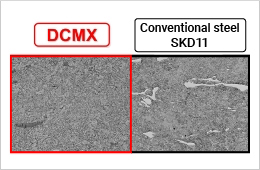
We evaluate and study microstructure control by combining heat treatment with content of alloying elements, and manufacturing process, as well as its effects on material properties.
We have developed a cold work die steel DCMX that have high hardness with higher toughness. We have also developed a new PVD coating method, taking advantage of the lifetime endurance evaluation technology by which high-tensile-strength steel plates are processed with progressive dies. We are also working on evaluating die materials using ultra-high-tensile-strength steel plates with strengths grade up to 1.5 GPa.
Powder for 3D Printers (Die Steel)
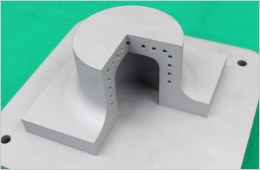
We are actively engaged in the development of new metal powders, focusing on “buildability that enables crack-free 3D-printing” and “thermal conductivity,” features that are considered essential for large-scale 3D-printing molds.
We evaluate the performance of 3D-printing molds made from our metal powder using our in-house 3D printers. This evaluation includes testing the molds' buildability and thermal conductivity using a heat checking tester and other equipment. We have developed additive manufacturing metal powders suitable for various metal 3D printers, such as SLM and LMD (HTC40 & HTC45, LTX, LTX420).
Stainless Steel
High strength Stainless Steel DSN® 9-H2 for hydrogen application
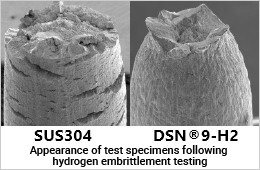
In hydrogen gas environments, many types of steel are prone to hydrogen embrittlement — a phenomenon that causes materials to become brittle. As a result, the steels used are typically limited to low-strength grades. To support the transition to a hydrogen society, we have developed DSN® 9-H2, a stainless steel that successfully combines high strength with excellent resistance to hydrogen embrittlement.
DSN® 9-H2 contributes to the downsizing and weight reduction of FCV components and hydrogen station components.
Superalloy
DSA760
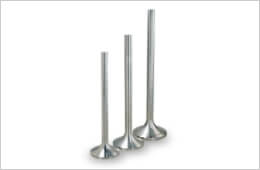
We have developed DSA®760, an alloy has the same level of hardness as martensitic stainless-steel, while being non-magnetic and high corrosion-resistance. These characteristics make DSA®760 an ideal material for shafts, fasteners, and bearings.
Furthermore, due to its excellent oxidation and high-temperature corrosion-resistance, this alloy is a widely applicable material for heat-resistant components, and is used, for exhaust valve in marine engines. DSA®760 contributes to extending the service life of corrosion-resistant components and improving the performance of heat-resistant components.