

Daido Carbon Neutral Challenge
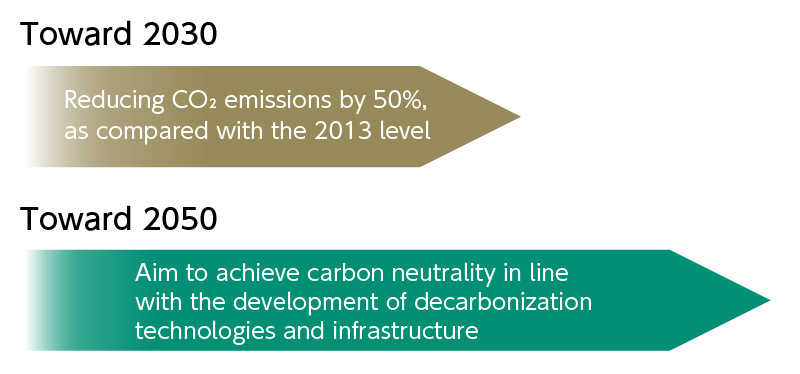
In order to realize its management philosophy of “Pursuing the potential of materials to support our future,” the Daido Steel Group considers action on climate change to be one of its most important management issues. As a part of this effort, we have formulated the “Daido Carbon Neutral Challenge” and are promoting initiatives aimed at reducing CO2 emissions by 50% in FY2030 compared to FY2013 and achieving carbon neutrality by 2050.
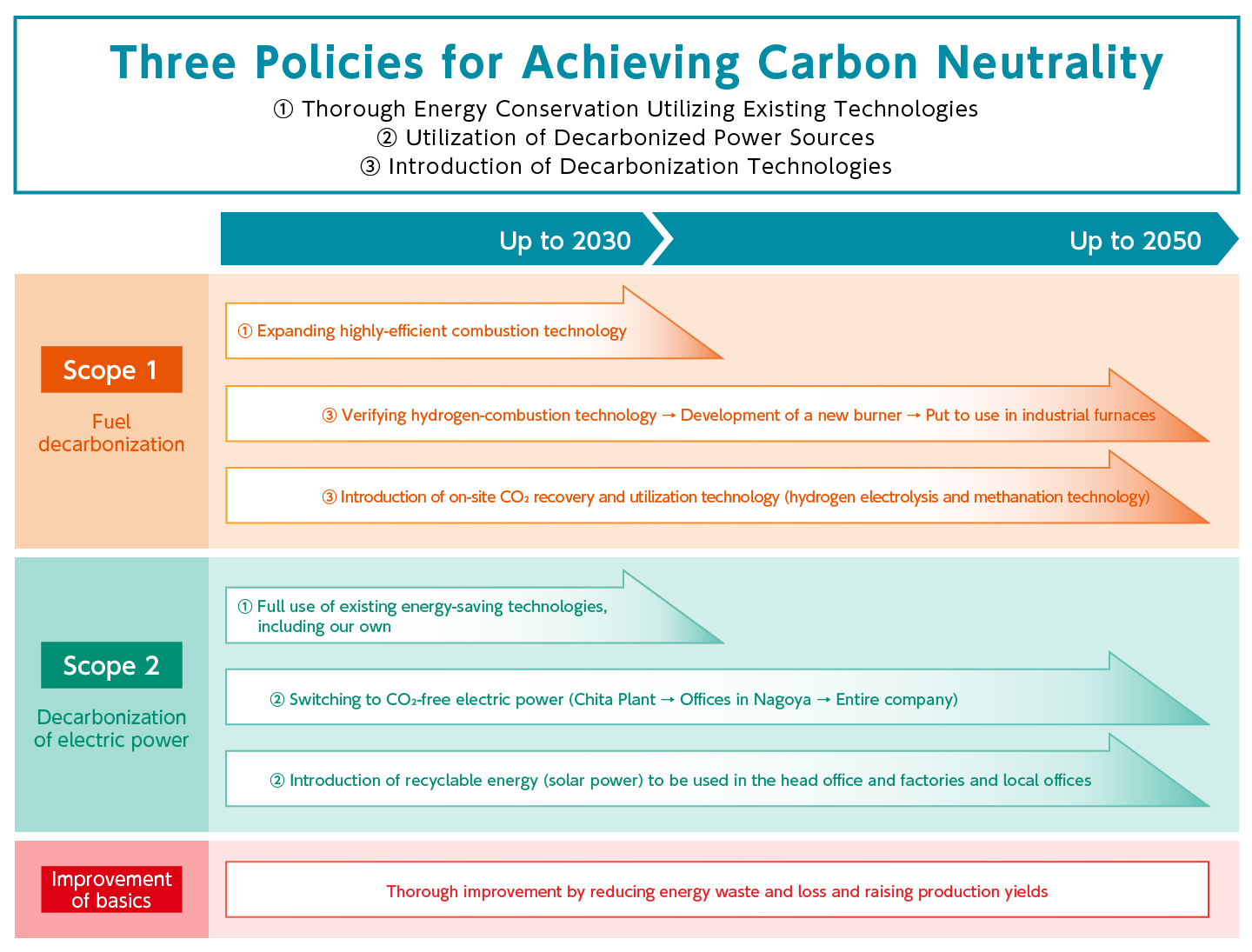
Three Policies
We will not only comply with the Act on Promotion of Global Warming Countermeasures and the Act on the Rational Use of Energy, but will also proactively engage in public policies related to climate change countermeasures and implement initiatives to reduce emissions.
The Carbon Neutral Action Plan formulated and published by the Japan Iron and Steel Federation (JISF) aligns with our company’s policies and goals, and we will continue to give it our support.
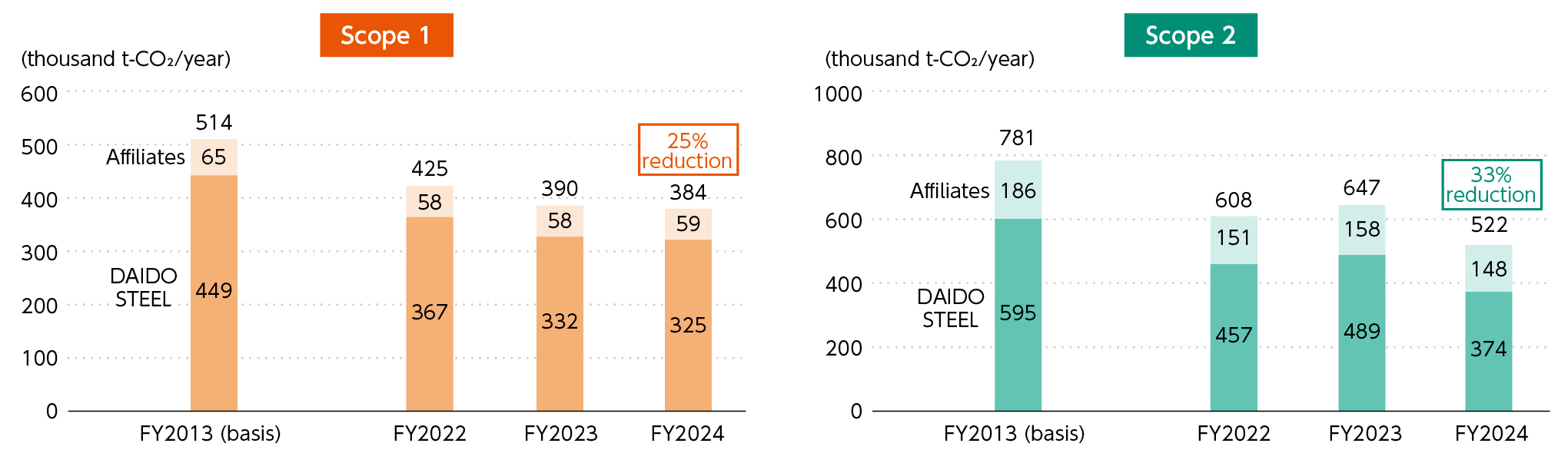
CO2 Emissions Results and Targets
![[Daido Steel Group CO2 Emissions Reduction Targets]](/en/common/img/pages/sustainability/eco/warming/img10.jpg)
Change in Scope 1 and Scope 2
Scope 3
We have conducted calculations for the possible Scope 3 categories 1, 2, 3, 4, 5, 6, 7, and 13 based on the "Basic Guidelines for Calculating Greenhouse Gas Emissions through Supply Chains."
In FY2023, overall CO2 emissions were confirmed to be 1,441 thousand tons, of which "Category 1: Purchased products and services" accounted for the largest percentage at 77%. In order to reduce CO2 emissions, we have introduced "Partners' Meetings" with our major suppliers in this fiscal year, during which we will engage in activities to calculate and reduce CO2 emissions from products for our company.
We will continue to work on product development and other activities to increase the ratio of products that can contribute to the reduction of CO2 emissions at our customers (e.g., high-performance materials used in EV vehicles and hydrogen-related products).
CO2 emissions by Scope 3 category
thousand t-CO2/year
| Category | FY2024 | |
| 1. Purchased products and services | 1,043 | Calculated by multiplying the purchase price and purchase weight of raw materials and materials by the CO2 emissions factor |
|---|---|---|
| 2. Capital goods | 73 | Calculated by multiplying capital investments by CO2 emissions factor |
| 3. Fuel and energy-related activities not included in Scope 1 or 2 | 179 | Calculated by multiplying purchased electricity and fuel by CO2 emissions factor |
| 4. Transportation and delivery (upstream) | 51 | Calculated by multiplying the amount of fuel used and the amount purchased under Category 1, as reported under the Act on Rationalizing Energy Use, by CO2 emissions factor |
| 5. Waste generated in operations | 15 | Calculated by multiplying amount of waste for each type of by-product by the CO2 emissions factor |
| 6. Business travel | 3 | Calculated by multiplying the money spent on each mode of transportation by the CO2 emissions factor |
| 7. Employee commuting | 3 | Calculated by multiplying the money spent on each mode of transportation by the CO2 emissions factor |
| 13. Leased assets (downstream) | 0 | Calculated by multiplying the leased surface area by the CO2 emissions factor |
| Total | 1,368 |
- * Calculations are limited to categories applicable to Daido Steel on a non-consolidated basis
- * Calculation method: IDEA LCI database Ver. 3.5 (April 15, 2025) used by IDEA Lab of AIST Research Institute of Science for Safety and Sustainability, and the emission factor database for corporate GHG emissions accounting over the supply chain (Ver. 3.5) used by the Ministry of the Environment.
- * Fiscal 2024 emissions results (Scope 1, Scope 2, Scope 3) are subject to third-party verification.
- * The total value represents the aggregate of all categories, including decimal places.
Additionally, the contribution to CO2 emissions reduction at customers for the Engineering Division's four major energy-saving products is calculated as 37,100 t/year (FY2024).
| Product Name | Contribution to CO2 emissions reduction (t/year) |
| Premium STC® | 1,200 |
|---|---|
| DINCS® (Highly-Efficient Combustion System) | 3,500 |
| ModulTherm® (Energy-Saving Vacuum Carburizing Furnace) | 23,000 |
| Sewage Sludge Carbonization Furnace | 9,400 |
Third-party verification of CO2 emissions
Information Disclosure Based on the Recommendations of the TCFD
In November 2021, we expressed our support for the TCFD recommendations and further strengthened our governance and clarified our strategy based on the TCFD recommendations. We will work to further enhance information dissemination and disclosure by communicating the risks and opportunities that climate change poses to our business in an easy-to-understand manner.
Governance
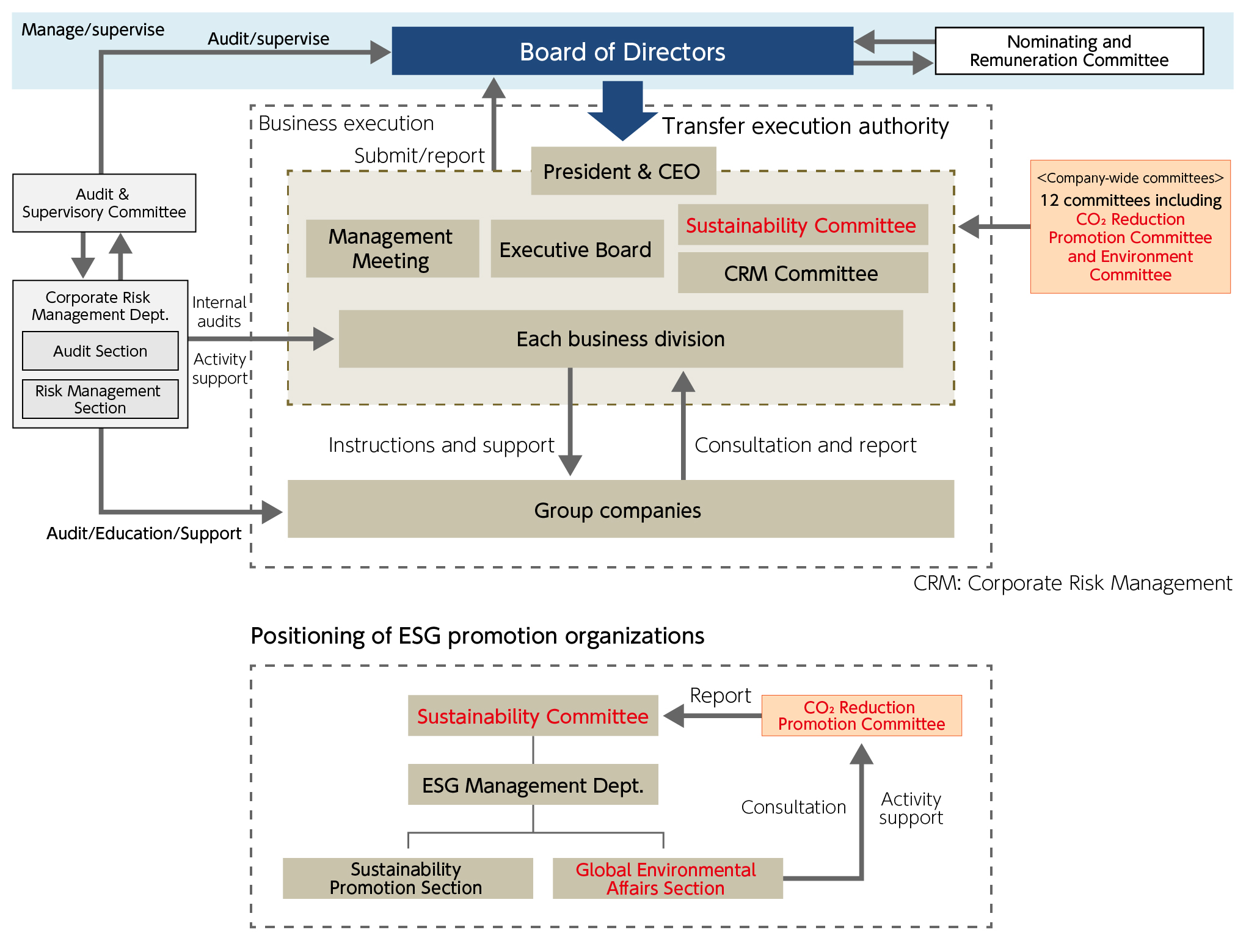
In April 2022, we reorganized the existing CSR Committee and established a new Sustainability Committee as an organization to review and deliberate basic policies, important matters, risks, and opportunities related to climate change. The Sustainability Committee is chaired by the President and CEO and submits matters discussed and decided by the Committee to the Board of Directors.
Additionally, as an organization addressing environmental and climate change risks, we established the ESG Management Department in January 2023 as the operational arm of the Sustainability Committee. Under this department, we renamed and established the former CO2 Reduction Project as the Global Environment Affair Section. This section is tasked with planning CO2 emissions reductions, rolling out initiatives company-wide, and strengthening their implementation.
Resolutions deliberated and passed by the Board of Directors are rolled out to individual business divisions, which reflect them in their business operations.
Strategy
In order to understand the risks and opportunities, and impacts of climate change on our company, and to examine the resilience of our medium- to long-term strategy and the need for further measures, we conducted a scenario analysis for the period 2030 - 2050. The scenario analysis referred to climate change scenarios (1.5℃ scenario and 4℃ scenario*) published by the International Energy Agency (IEA) and the Intergovernmental Panel on Climate Change (IPCC). We conducted a thorough review of risks and opportunities, focusing on those with the highest potential impact on our business. These risks and opportunities were selected from the perspectives of “those with a high likelihood of occurring” and “those that will have a significant impact when they occur," and we subsequently considered measures to mitigate such risks and capitalize on opportunities. We will also continue to closely monitor risks and opportunities that were not included in the analysis this time.
After examining the measures to address each risk and opportunity, we have concluded that we can improve our corporate value by developing and expanding sales of high-performance materials and innovative environmentally-friendly engineering products based on the basic strategies of our medium- to long-term management plan in response to social transformation toward decarbonization. We thus concluded that our strategy has a sufficient level of resilience.
* 1.5℃ scenario: a scenario in which measures such as tighter regulations and market changes are taken to minimize temperature rise.
4℃ scenario: a scenario in which temperature rise results in extreme weather events and other physical impacts
| Scenario | Factor | Change | Impact on our company | Our measures | |
| 1.5℃ | Progressive shift to EVs | Reduced demand for engine/exhaust system parts due to progressive shift to EVs | RiskMedium |
|
|
| Increased demand for high- performance materials caused by the progressive shift to EVs | OpportunityHigh |
|
|
||
| Strengthening of various regulations, including those governing greenhouse gas emissions | Increase in electricity costs due to use of renewable energy | RiskLow |
|
|
|
| Introduction of carbon pricing | Increase in operating costs | RiskLow |
|
|
|
| Rising demand for electric arc furnace materials | OpportunityMedium |
|
|
||
| Rising demand for scrap raw materials increase in scrap procurement costs | Rising demand for scrap raw materials increase in scrap procurement costs | RiskMedium |
|
|
|
| Diffusion of technology to address issues related to the environment and new energy | Rising demand for innovative engineering to address environmental issues | OpportunityHigh |
|
|
|
| Rising demand for hydrogen-related technology and products | OpportunityMedium |
|
|
||
| 4℃ | Increasingly intense (acute) climactic damage | Risk of operations being suspended due to natural disasters on business partners and production sites | RiskMedium |
|
|
The degree of impact for high, medium, and low is evaluated based on our current assumptions and anticipations.
We believe that this will change depending on the situation, and we will continue to review our evaluation.
- High: It is anticipated that there will be a major impact on finances and business.
- Medium: It is anticipated that there will be some impact on finances and business.
- Low: It is anticipated that there will be a minor impact on finances and business.
Risk Management
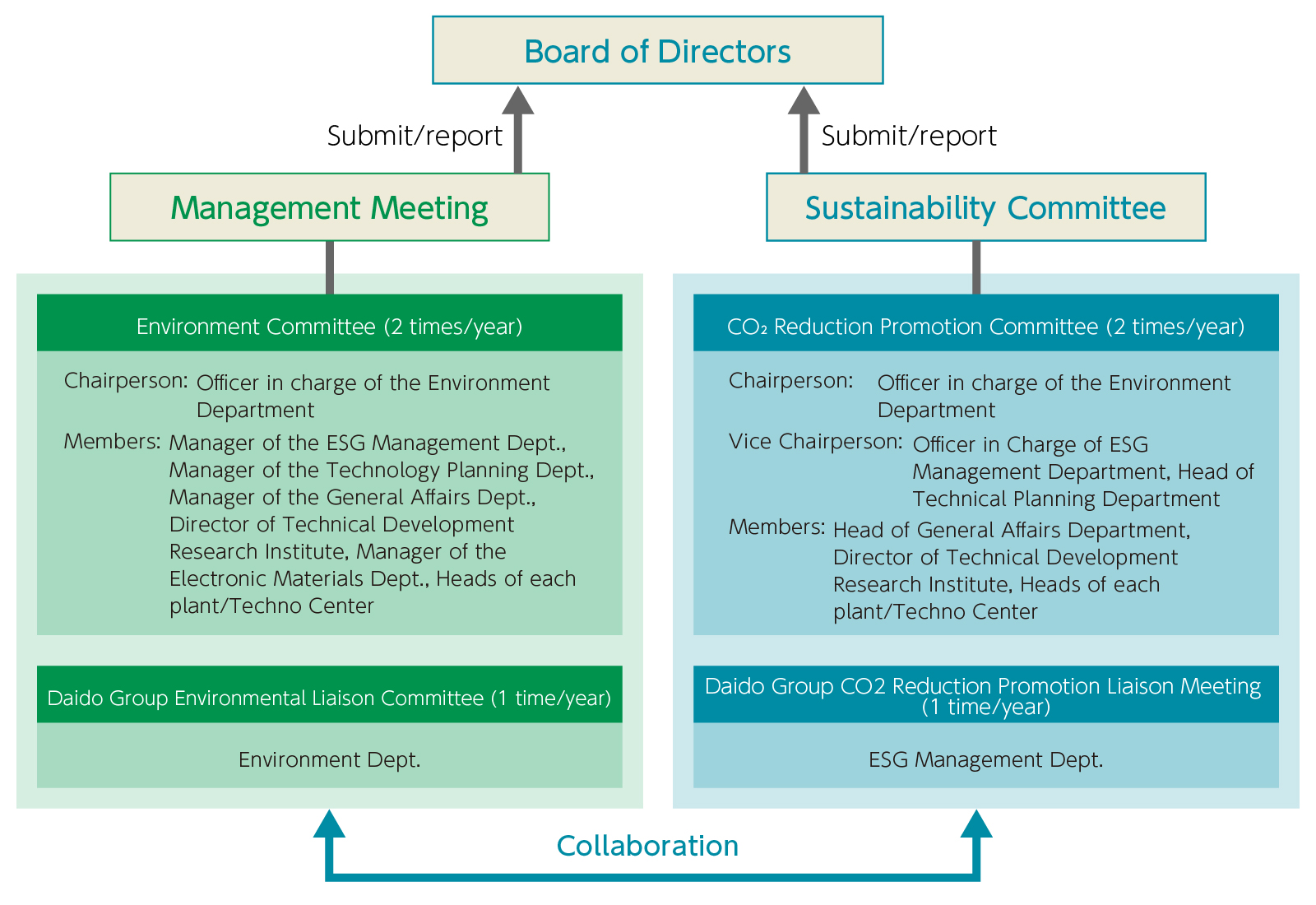
As a process for managing climate-related risks, climate-related risks are analyzed, measures to address them are drafted and promoted, and progress is managed through the Sustainability Committee.
Details of matters analyzed and considered by the Sustainability Committee reported to the Board of Directors, and management of risks is integrated across the Company as a whole.
We conducted scenario analyses on climate-related risks, centered on the ESG Management Department. After taking into account Daido Steel’s business strategy, considering the likelihood of each risk and opportunity occurring and their impact in the event that they do occur, and prioritizing climate-related risks, we will focus on measures to address those with the highest impact. The ESG Management Department, which operates the Sustainability Committee, will continue to identify and evaluate risks and opportunities in the future.
Indicators and targets
In order to assess and manage the impact of climate-related problems on management, Daido Steel has set reduction targets using total emissions of greenhouse gases (CO2) as indicator.
The Daido Carbon Neutral Challenge was announced in April 2021. The Company established a reduction goal of reducing 2030 CO2 emissions by 50% over those of fiscal 2013, and of achieving carbon neutrality in 2050.
Furthermore, when formulating the 2026 Medium-Term Management Plan, we expanded the scope to include the Daido Steel Group, including domestic and overseas affiliates. The entire group is working together to promote activities to reduce CO2 emissions.